
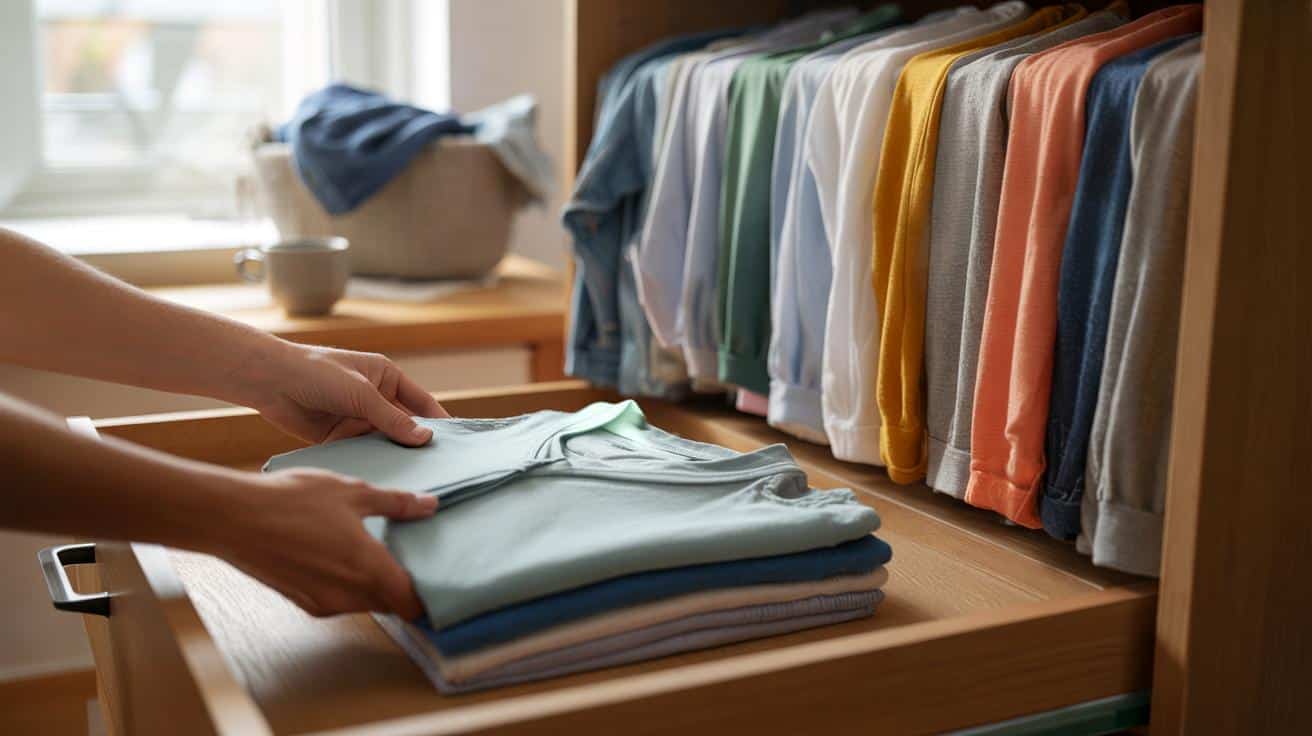
Drawers jam, collars stretch, socks drift off in pairs. It feels small, yet it adds up. There’s a smarter way to fold that calms the drawer, saves minutes, and keeps fabric from giving up before its time.
The living room was a soft tumble of cotton and steam, the telly humming low as Sunday evening settled in. My neighbour, the kind who knows the quickest way to do everything, nudged a heap of T‑shirts to one side and watched me wrestle a hoodie. She smiled, rolled her sleeves, and started folding in a way I’d never seen. Each shirt became a neat little book, then—this was the magic—stood upright like a row of paperbacks. *I swear the pile shrank before my eyes.* She tapped one with a fingertip, and it didn’t budge. Then she said the quiet part out loud. “This way, your clothes stop fighting you.” I leaned closer. Then the stack stood up.
Why standing clothes save time and last longer
The enemy of tidy drawers isn’t your kids — it’s horizontal piles. Flat stacks force you to lift and slide garments just to see what you own. Each rummage pulls fibres, drags hems, and creases collars. When clothes stand like files, you see everything at once. You grab one piece without yanking the rest. Your drawer becomes a quiet library, not a wrestling ring.
I road-tested it for a week with a kitchen timer. Same load, same telly, same tea. Folding time? Down by a chunk, simply because nothing needed re-folding after I picked the wrong top. The small wins add up: fishing out gym shorts in five seconds, matching socks without digging, giving a shirt a quick smooth and slotting it upright. In a tiny London flat where every drawer is a squeeze, visibility is gold.
Here’s the fabric bit, put simply. The more your clothes rub against each other, the faster they look tired. Micro-abrasion from sliding piles raises fuzz, fades colour, and loosens seams. Vertical “file folds” reduce friction because garments aren’t shuffling as a block. Weight sits through the fold’s spine rather than pulling at the neckline. Less rummaging equals less rubbing, which means longer-lasting clothes. Heat is kinder too: fewer deep creases means less ironing, and less ironing means less wear. Hangers leave shoulder bumps on knits; files don’t.
The clever fold: the Half‑Turn File Method
Lay the garment flat and smooth with your palms. Fold sleeves in so the body becomes a clean rectangle, roughly the width of your hand. Fold the length into thirds, then pinch the centre and give a tiny half turn to form a “spine” that helps it stand. For T‑shirts, tuck the hem inside so edges hide; for gym tops, expel air gently as you fold so they don’t spring open. The test: place it on its “spine” and watch it stand.
Jeans? Button or zip, smooth, fold one leg over the other, then fold into thirds and add that small half turn at the end. Jumpers need a lighter touch: fold arms in softly, then thirds without pressing hard. Hoodie hoods fold last and tuck into the middle. Stack by height so everything lines up like books. Let colours run in a comforting gradient. Let it look a little satisfying. Let it stay that way.
After a few tries, your hands learn the motion and your brain stops thinking about it. Fold to stand, not to stack. The only real mistakes: over-squashing stretchy knits, making every item the same tightness, or mixing heavy denim in with delicate tees. Give heavier items their own row at the back. Keep light pieces up front. Let’s be honest: nobody really does this every day. Do it once after the main wash, and you’ll coast for the week.
“Wardrobe departments file-fold on tour because it keeps shapes crisp and changes quick,” says a theatre dresser in Manchester. “If performers can grab a top in the dark without wrecking the rail, you know it works at home.”
- Quick setup: smooth, rectangle, thirds, half turn, stand.
- Best for: T‑shirts, jeans, joggers, pyjamas, kids’ clothes.
- Maybe skip: stiff dress shirts, delicate silk, heavy coats.
- Tools: your hands, a clean surface, a drawer or box to file into.
Make it last: the little habits that change everything
Once clothes stand, the rest follows. You stop squeezing drawers shut and stop kneeling on the floor to see the bottom of a pile. Laundry day loses its sting because you aren’t refolding what you’ve already folded. Treat knits with a soft hand. Let T‑shirts dry flat for a few minutes before folding so they keep their shape. Rotate pieces front to back every week so the same favourite doesn’t take all the wear. Small habits, big peace.
| Point clé | Détail | Intérêt pour le lecteur |
|---|---|---|
| File-fold vertically | Garments stand like books, not piles | See everything at a glance and stop re-folding |
| Half-turn spine | Tiny twist creates structure in the fold | Clothes stay upright and resist collapsing |
| Group by weight and height | Heavier denim at the back, light tees up front | Smoother access, less friction, longer life |
FAQ :
- Does this work in shallow drawers?Yes. File-folding thrives in low drawers and boxes. If items tilt, tighten the thirds slightly and add a small cardboard divider or a spare shoe box as a lane.
- Won’t more folds mean more creases?Not with smooth palms and thirds. Flat stacks crease because weight sits on top. Standing folds spread pressure along the spine, so collars and fronts stay flatter.
- What about shirts on hangers?Hang crisp dress shirts to keep sleeves sharp. For casual shirts, file-fold keeps shoulders bump-free and frees rail space. Mix and match by fabric and occasion.
- How do I teach kids this?Turn it into a game: “Make your T‑shirt stand up.” Use a book as a width guide. Celebrate the first wobbly wins. Easy motions stick faster than tidy lectures.
- Do I need a folding board?No. Hands are faster after two or three loads. A board helps for uniform stacks in wardrobes, but speed and less friction come from the vertical file itself.







Just tried the half‑turn “spine” on my T‑shirts—they actually stand up like little paperbacks 🙂 Drawer visibility is 100% better and nothing collapses when I grab one. Honestly feels calmer, and I ironed less because collars weren’t getting squashed.